International Agro — Issue 16
In Argentina, proof of origin got its own price on the futures market, and the fight is now over who owns the platform that produces it. In the United States, the government will pay $8 billion for harvest diesel based on a loss calculated by a model, not a receipt. In Europe, ministers try to close the new CAP by first deciding who counts as a farmer.
English Gabriel Rondon
🌐 Em português: Agro Internacional — Edição 16
Argentina put a price on proof, the United States will pay for a loss nobody has to prove, and Europe opens the new CAP by deciding who is a farmer. Every week I read the world’s agriculture looking not for the news, but for the layer it hides.
In Argentina, on 23 October 2026, La Nación reported that the A3 Mercados futures exchange started accepting a different soybean: the soybean that proves it did not come from deforestation.
In the United States, on 19 October, USDA announced $8 billion in one-time payments to ease the cost of diesel at harvest.
In Europe, this Monday, 26 October, agriculture ministers meet in Luxembourg to try to close the non-financial part of the CAP after 2027.
It looks like three stories. It is one.
Argentina: the soybeans and the cattle exist, the proof became a commodity with a contested owner
From this week, A3 Mercados enables the “SOJA VISEC” delivery condition on its dollar soybean futures contract for delivery in Rosario, according to La Nación on 23 October 2026.
To deliver, the soybeans must meet the ordinary soybean quality standard and prove compliance with the European Regulation 2023/1115 (EUDR), through the Visec system or another one A3 designates.
The mechanism is a “pase”, a spread: one buys one soybean and sells the other for the same expiry. The spread’s price, in dollars per ton, is the difference between the two. In other words, it is the price of the proof, on its own.
Premiums for traceable soybeans run from $2 to $8 per ton, according to La Nación. The Visec Soja platform had about 12,000 registered producers, covering more than 5 million hectares, and adds more than 300 sign-ups a day, according to Gustavo Idígoras, president of Ciara-CEC.
The detail: Visec Soja was developed by the private sector, led by exporters. It “monitors, reports and verifies”, according to La Nación. It does not certify.
In beef, the same logic is already causing friction. On 22 October, Confederaciones Rurales Argentinas (CRA) denounced that exporting meatpackers pay less for cattle from farms not registered on Visec Carne, according to La Nación.
“There is no European or Argentine rule that obliges the producer to register on any platform,” CRA said. Daniel Urcía, of Fifra, replied that he knows of no specific cases, and that the exporter can simply decline to buy from those who do not deliver the documentation.
On 26 October, Pablo Ginestet, president of Carbap, wrote in La Nación: “The goal cannot be that all producers depend on a single platform.” He asked for competition between platforms, interoperability and use of public registries.
The other side of the ledger came from consultant Víctor Tonelli, also in La Nación, on 25 October. Boneless beef sold to Europe averaged $14,615 per ton, against $7,535 for other destinations.
What proof is worth in beef
Average price of exported boneless beef ($ per ton)
Europe took 11% of the volume and 19.4% of the value of boneless cuts exported in the first nine months of the year, according to Tonelli.
The hidden machinery: the soybeans and the cattle are the same. What was born this week is a separate price for the proof, tradeable on an exchange. And once proof becomes an asset, the question is no longer whether it is needed, but who holds the data that produces it. Producers are not fighting the European rule. They are fighting the fact that the registry that grants market access belongs to the people who buy from them.
United States: the diesel exists, the loss is a model
On 19 October 2026, USDA announced Harvest Fuel Relief: $8 billion “available for one-time payments to American farmers this harvest season”, according to the release reproduced by RFD-TV.
The money comes from the Commodity Credit Corporation and will be administered by the Farm Service Agency (FSA), according to Agri-Pulse. It does not require a crop insurance link.
The core is the formula. USDA will use “a uniform formula to cover a portion of modeled losses during the 2026 crop year”, according to the release. The national loss average will be built from FSA-reported planted acres, Economic Research Service cost-of-production estimates, and WASDE yields and prices.
Nobody has to show a diesel receipt. Commodity-specific payment rates come out in November, and the method for other crops “will be announced at a later date”, according to USDA. Specialty growers were invited to email fuel-cost data to HarvestFuel@usda.gov.
The model replicates Farmer Bridge Assistance, which paid $12 billion to over 560,000 farmers, according to USDA.
The American Farm Bureau Federation projects about $8 more in diesel per acre of corn, and $2,227 more for the average farm, according to Moneywise, republished by Yahoo Finance on 23 October 2026. Retail diesel hit a record $6.50 per gallon in September, according to Bloomberg cited by Farm Policy News, with exports constrained in the Strait of Hormuz by the conflict with Iran.
“A Band-Aid response now, 2 weeks before the election, doesn’t fix the problem,” said Aaron Lehman, president of the Iowa Farmers Union, on 20 October.
The hidden machinery: the state does not pay the cost the farmer incurred. It pays the cost a model says the farmer should have incurred, built from three official databases. That makes the payment fast and cheap to audit. It also moves trust: what counts is not the farm’s receipt, but the acreage record at FSA and the ERS spreadsheet. Those who are well registered get paid. Those who spent more than the average do not.
Europe: the farmland exists, the fight is over who counts as a farmer
The Agriculture and Fisheries Council meets in Luxembourg on 26 and 27 October 2026. Item 5 on the agenda is the post-2027 CAP regulation, for a “partial general approach”, according to the Council’s provisional agenda of 23 October.
Partial because what involves money stays out. Capping and degressivity of payments remain in brackets, tied to the 2028-2034 budget negotiation, according to Agence Europe on 22 October.
What goes in is the definition of who gets paid. The Irish presidency’s compromise text, published on 21 October, limits support to farmers with a minimum level of agricultural activity, which may include part-time farmers, according to Agence Europe.
Each member state may use criteria such as income tests, labour inputs on the farm, company object, or registration in national or regional registers, including in the form of a negative list.
The same text creates an article with minimum checks to confirm that declared land is actually at the farmer’s disposal. And it raises the annual ceiling on coupled support from €4 million to €6 million, according to Agence Europe.
On 28 September, ministers had already asked for clearer definitions and simpler rules. “Farmers need a policy that provides stability and a fair income,” said Irish minister Martin Heydon, who chairs the Council.
On the same 26 October agenda, Italy asks to extend the exceptional temporary EAFRD support to cover higher agricultural fuel costs. The expensive diesel is the same on both sides of the Atlantic.
The hidden machinery: before discussing how much each one gets, Europe has to decide who exists for the system. An income test, a register, a check that the declared land belongs to whoever declares it. The money has not even been divided, and the identity ruler is already being written. It decides whether the euro reaches the person who farms or the one who merely holds the title.
The synthesis: the commodity is there, what is contested is the registry that recognizes it
Take the three out of this week’s headlines.
In Argentina, the soybeans and the cattle exist, but they only fetch the European price with proof generated on a platform owned by the buyers. In the United States, the diesel cost exists, but the state pays for a loss modeled on the acreage record. In Europe, the farmer exists, but the right to support depends on a test still being drafted.
In none of the three is the problem the physical thing.
What decides is the registry: the database that attests origin, the declared acreage that feeds the model, the list that says who is a farmer. And in all three, whoever controls the registry has power over the price, the payment or the right.
It is the lesson Brazil knows from the inside: the world’s largest herd barely becomes capital, not for lack of cattle, but for lack of proof a third party will accept. (I wrote about this in The Cattle That Won’t Become Capital.)
The next frontier of agriculture is not producing more. It is deciding who keeps the registry that turns production into value, and whether that registry can be verified by more than one side.
Notes and sources (week of 26 October 2026)
- Argentina, “SOJA VISEC” delivery condition at A3 Mercados, spread mechanism, premiums of $2 to $8 per ton, about 12,000 producers and over 5 million hectares, more than 300 sign-ups a day, statements by Gustavo Idígoras: La Nación, Fernando Bertello, 23 October 2026.
- Argentina, CRA complaint about discounts on cattle outside Visec Carne and reply by Daniel Urcía (Fifra): La Nación, 22 October 2026. Op-ed by Pablo Ginestet (Carbap): La Nación, 26 October 2026. Prices of $14,615 and $7,535 per ton, 11% of volume and 19.4% of value: Víctor Tonelli, La Nación, 25 October 2026. Quotes translated from Spanish.
- US, Harvest Fuel Relief, $8 billion, formula on modeled losses, FSA planted acres, ERS and WASDE, rates in November, $12 billion Farmer Bridge Assistance to over 560,000 farmers: USDA release reproduced by RFD-TV, 19 October 2026, and Agri-Pulse, 19 October 2026. Record diesel of $6.50 per gallon: Farm Policy News, 20 October 2026. AFBF projections ($8 per acre, $2,227 per farm) and Aaron Lehman’s statement: Moneywise via Yahoo Finance, 23 October 2026.
- EU, provisional agenda of the Agriculture and Fisheries Council of 26 and 27 October 2026 (doc. 14448/26), including Italy’s EAFRD fuel request: Council of the EU, 23 October 2026. 21 October compromise text, active farmer, land checks, coupled support from €4 million to €6 million, capping and degressivity in brackets: Agence Europe, 22 October 2026. 28 September meeting and Martin Heydon’s statement: Irish presidency.
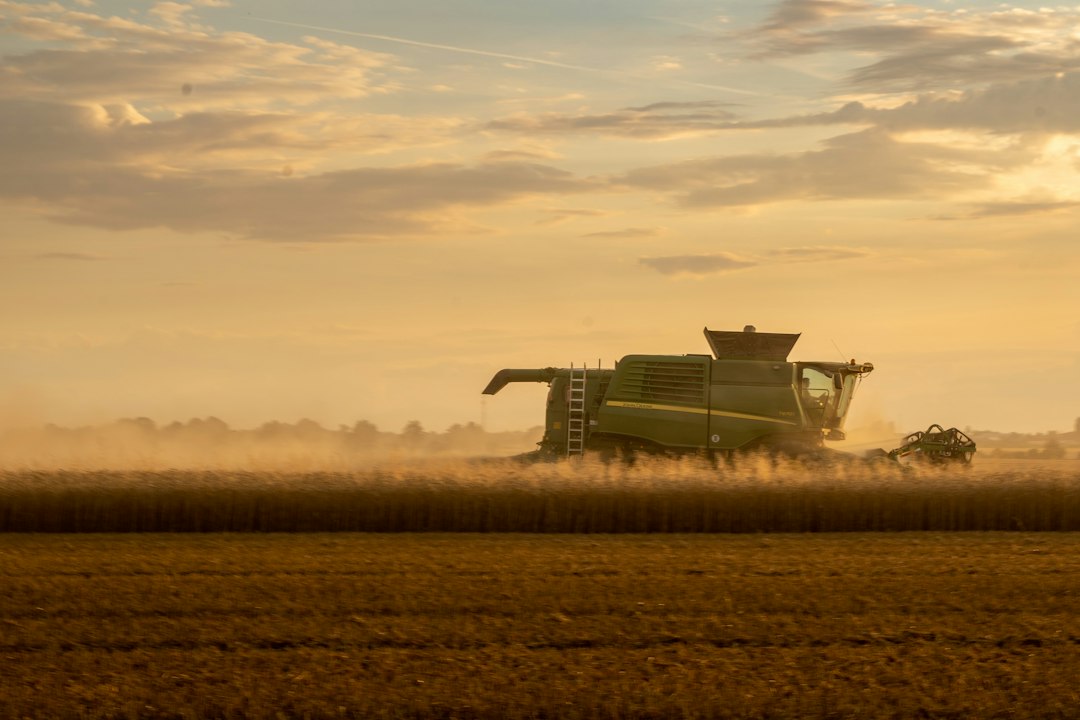
- Photo: Jakub Brabec / Unsplash